The Ultimate Vision Board Checklist: How to Create One That Actually Works
Introduction: Why Vision Boards Still Matter (When Done Right)
Let’s get one thing out of the way: most vision boards don’t work.
Why? Because they’re treated like pretty scrapbooks, not like what they really are: a tool for training your brain.
If you’ve ever glued down a few magazine cutouts, hung the board on your wall, and then watched your dreams… not arrive, you’re not alone.
And here’s the part most vision board guides won’t tell you. The psychologist Gabriele Oettingen found that just fantasizing about a dream future can actually make people less likely to reach it. The good feeling tricks your brain into relaxing, as if you’d already arrived.
So the problem was never your dreams. It was looking without moving.
That’s where vision boards, done the right way, change everything.
Think of your brain as a high-powered filter. It constantly scans your surroundings, deciding what matters and what doesn’t. Give it a clear, emotionally charged vision, and its filter, the reticular activating system, starts working for you. You begin to spot opportunities you used to walk past.
And when you pair that vision with action, it stops being a daydream and becomes a map.
That’s why this checklist matters. It isn’t about crafting the prettiest board. It’s about building a board that makes your whole system sit up and say: This is who I am now. Let’s make it real.
1. Get Clear: Your Vision Needs Definition, Not Fluff
Here’s the harsh truth: if your vision board is full of vague words like “happiness”, “abundance” or “success”, your brain won’t know what to do with it.
Your brain’s filter doesn’t chase abstract poetry. It chases specific cues.
So before you ever touch scissors or open Pinterest, you need radical clarity. Ask yourself:
What would I stop tolerating if I fully stepped into my power?
What do I deeply crave, not because I “should”, but because it lights me up?
What would my future self look back on and thank me for choosing?
These aren’t surface-level affirmations. They’re filters that separate your real desires from the noise. Because let’s be honest: half the images in magazines aren’t your dreams. They’re someone else’s marketing.
Your board should reflect what’s yours. The home that truly feels like you. The work that gives you goosebumps. The relationships that nourish you. And don’t stop at one area: look at your whole life, from money and love to your body, your friendships and your joy.
Your move: Write it down before you hunt for images. Specific, emotional words give your brain a clear target before the pictures even show up.
Think “a bright home near the water, with space for long family dinners” instead of “house”.
Think “speaking with confidence in front of 200 people” instead of “success”.
Clarity isn’t just nice. It’s the foundation. Without it, your vision board is just clutter. With it, it’s a map.
2. Gather Your Materials: Paper or Digital?
Here’s the fun part: bringing your vision into form. And don’t get hung up on whether your board should be “old school” or digital. Both work, if you work them.
The traditional way
Poster board or corkboard: your canvas. Big enough to hold your future, sturdy enough to sit where you’ll see it.
Magazines or prints: look for images that light something up in you, not flat stock photos.
Scissors and glue: obvious, yes. But there’s something powerful about cutting and pasting with your own hands.
Flipping through pages, cutting, arranging: it tells your body, I’m building this with my own hands. That’s embodiment in action.
The digital way
Canva, Pinterest, design apps, or even your phone’s wallpaper. The advantage? You always have it with you, and you can update it as your vision grows. (More digital ideas in step 6.)
Which one is better?
Neither. What matters is the feeling you bring to it.
A glossy poster board collecting dust in the corner does nothing. A simple collage as your laptop wallpaper that lights you up every time you open it? That’s gold.
What’s non-negotiable: your board must feel alive. It must remind you every single day of the life you’re choosing.
Checkpoint: Before you move on, ask yourself:
Am I clear on what I truly want?
Do I have the tools, on paper or on screen, to bring it into form?
If yes, you’re ready to choose the images and words that make your board magnetic.
Ready to stop waiting and start moving?
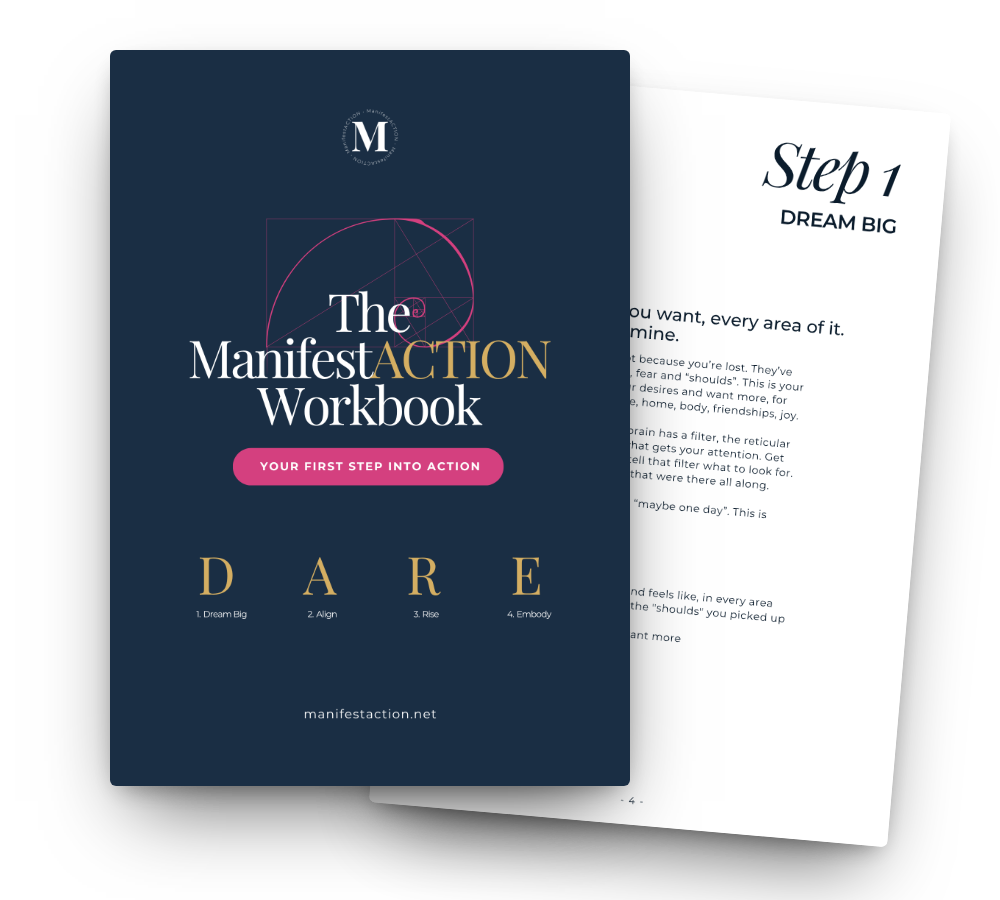
The free ManifestACTION Workbook walks you through all four steps of D.A.R.E.: find what you really want, train your brain to believe it, live as the woman who already has it, and take the first small action. So you stop waiting and start collecting proof.
3. Choose Images and Words That Spark Emotion
Here’s where most vision boards fail: they look pretty but feel empty.
Your brain doesn’t care about a random picture of a beach house or a stock photo of a smiling model. What it cares about is emotion. That’s what tells your system: This matters. Pay attention.
When you choose images and words for your board, ask yourself:
Does this make my chest expand, my pulse quicken, or my eyes light up?
Do I feel an inner “yes” when I see it?
Does it pull me forward into possibility?
If not, leave it out.
The science: Your brain pays more attention to things that carry emotion. Researchers have shown that emotional images and words grab our attention faster and stick in memory longer. And dopamine, the brain chemical linked to motivation, gets you moving toward a reward you’re excited about. That’s why a board that moves you works better than one that just looks nice.
Your checklist for powerful vision board content:
Images that stir emotion, not just aesthetics
Power words or phrases: short, bold, activating
Colors that lift your energy: trust your gut here
A balance of realistic and aspirational: stretch yourself, but don’t lose the connection
Remember: this isn’t about impressing anyone. It’s about creating a board that makes you feel something every single time you look at it.
4. Build It With Intention: Energy Over Aesthetics
Another myth to throw out right now: a vision board isn’t supposed to be a Pinterest-perfect design project.
Sure, make it beautiful if that lights you up. But the real power isn’t in symmetry or color palettes. It’s in the state you’re in while you create it.
Think of creating your board as a ritual:
Put on music that makes you feel alive.
Light a candle.
Ground yourself before you begin: close your eyes, breathe, and picture your future self.
Then build, with that feeling flowing through you.
Here’s what I’ve noticed again and again: a board thrown together while stressed and distracted feels flat. A board created when you’re calm, present and tuned in feels magnetic. Every time you look at it, it brings you back to the state you made it in.
Your move: Don’t rush this. Block out an hour or two, just for you. Make it intentional. Make it special. This isn’t scrapbooking. This is future-building.
5. Place It Where Your Brain Can’t Ignore It
Here’s the neuroscience kicker: repetition rewires your brain. Every time you see your vision board, you send your system the message: This is my life in progress.
But it only works if you actually see it. Often.
Too many people create a gorgeous vision board, and then hide it behind a closet door or under the bed. Out of sight, out of mind, out of results.
Instead, put your board where you can’t help but notice it:
On your bedroom wall, so it’s the first and last thing you see every day
Above your desk
As your phone or laptop wallpaper, if it’s digital
And when you look at it? Don’t just glance. Take a breath. Feel into it. Imagine stepping into that life right now.
The science: Neuroplasticity, your brain’s ability to rewire itself, thrives on repetition plus emotion. The more often you combine both, the stronger the new patterns become.
Remember Gabriele Oettingen from the beginning? Her research shows what turns dreaming into doing: picture the dream, then name what’s in your way, and plan your next step. She calls it mental contrasting.
Your daily 60-second practice:
Look at your board and pick one image or word.
Close your eyes and feel what it would be like if it were already real.
Ask: What’s in my way right now?
Decide on one small step you’ll take today.
That’s it. One minute. Do it daily, and you’ll be amazed at how much momentum builds.
6. Go Digital (or Create a Vision Book): Modern Manifestation Tools
Let’s be real: we live in a digital-first world. Old-school poster boards aren’t dead. But you have more tools at your fingertips than ever before.
Digital vision boards
Pinterest: a powerhouse for visual inspiration. Create a secret board just for your vision, and pin only the images that give you a full-body yes. Don’t pin random pretty pictures. Pin with intention.
Canva or design apps: build a custom collage and save it as your phone or laptop wallpaper. Always visible means constant brain training.
Mood board apps: tools like Milanote, Notion or Trello work well if you like structured, flexible layouts.
Vision books
Prefer something you can hold, but still flexible? Create a vision book, a living, breathing manifestation journal:
Print and paste your images into a notebook.
Add handwritten affirmations or journal entries next to each vision.
Keep updating it as you grow.
Want it ready-made? The ManifestACTION Planner combines your vision with daily planning: space to write your dream life, plus the steps to live it, day by day. (Link: your Amazon link)
The key? Keep your vision close. Whether it’s a board on your phone or a book on your nightstand, it should travel with you, ready to be seen and felt.
7. Tune Your Frequency: Become a Match for What You Want
Here’s the secret most vision board guides skip: it’s not the images that change your life. It’s who you become while you look at them.
Everything vibrates, and your brain runs on measurable rhythms, too. When your thoughts, emotions and actions match the life you want, things click. When they don’t, everything feels like pushing uphill.
So how do you tune yourself?
Meditation: not about zoning out, but about calming the mental noise so you can hear what you really want.
Visualization: step into one specific scene from your board. Feel the sounds, textures and emotions as if it’s happening now.
Gratitude: the psychologists Robert Emmons and Michael McCullough found that people who regularly wrote down what they were grateful for felt better about their lives and more optimistic. Start small: three things a day.
Daily embodiment: don’t just hope. Act as if. If your board shows you confident on stage, speak up more in everyday life. If it shows financial freedom, start making aligned money decisions today.
The science: Calm, relaxed states show up as slower brainwave patterns (alpha and theta), which are linked to relaxation and creative thinking. Visualization and meditation help you reach those states, so your mind is more open to new ideas.
8. Keep It Alive: Grow With Your Vision
Here’s the final, non-negotiable truth: your vision isn’t static. And neither should your board be.
Too many people create a vision board, love it for two weeks, then let it gather dust until it feels like an old souvenir. That kills momentum.
Treat your board like a living document of your growth:
Check in monthly. What still excites you? What feels outdated?
Celebrate your wins. When something on your board shows up in your life, don’t just replace it. Celebrate it, and write it down. That’s your evidence.
Let your vision grow. As you rise, your desires will too. Don’t fear this. Growth is the point.
Conclusion: Your Future, Your Move
At this point, you’re not just cutting and pasting. You’re building a system that connects your brain, your emotions and your actions to the life you want.
To recap:
Clarity first: know what you actually want.
Choose with emotion: your brain responds to feeling, not fluff.
Build with intention: energy over aesthetics.
Place it where it works: repetition rewires.
Use modern tools: digital boards, vision books or your planner.
Tune your frequency: feel it, live it, act on it.
Keep it alive: grow as you grow.
And never forget the most important step: a vision board shows you the way. Only you can walk it.
Because here’s the truth: you’re not here to dream small or wait politely. You’re here to shape your life like the creative force you are. Your vision board is more than paper and glue. It’s the daily reminder of what’s possible, what’s yours, and what you’re no longer willing to settle for.
So go ahead. Build it. Feel it. Then take the first step.
Your board isn’t just a collage. It’s your declaration.
To your next move,
Verena
Your next move starts here.
The free ManifestACTION Workbook walks you through all four steps of D.A.R.E.: find what you really want, train your brain to believe it, live as the woman who already has it, and take the first small action. So you stop waiting and start collecting proof.